
DISC vs Big 5
Assess FirstDISC vs Big Five – What Should You be Using
Comparing DISC and Big Five: Which is More Accurate?
Are you torn between DISC vs Big Five personality assessments? This article breaks down the pros and cons of each to help you make an informed decision. When it comes to personality assessments, two popular options are DISC and Big Five. Both offer valuable insights into an individual’s personality traits, but they differ in their approach and focus. In this article, we’ll explore the pros and cons of each assessment to help you decide which one is right for you or your organisation.
Understanding DISC and Big Five personality assessments
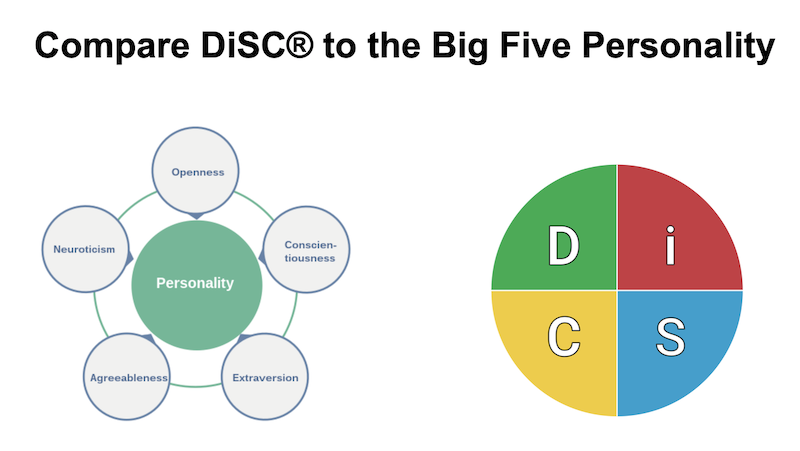
DISC vs Big Five are two popular personality assessments used in various settings, including workplaces, schools, and personal development. DISC focuses on four main personality traits: dominance, influence, steadiness, and conscientiousness. On the other hand, the Big Five measures five broad dimensions of personality: openness, conscientiousness, extraversion, agreeableness, and neuroticism. Understanding the differences between these assessments can help you choose the one that best suits your needs.
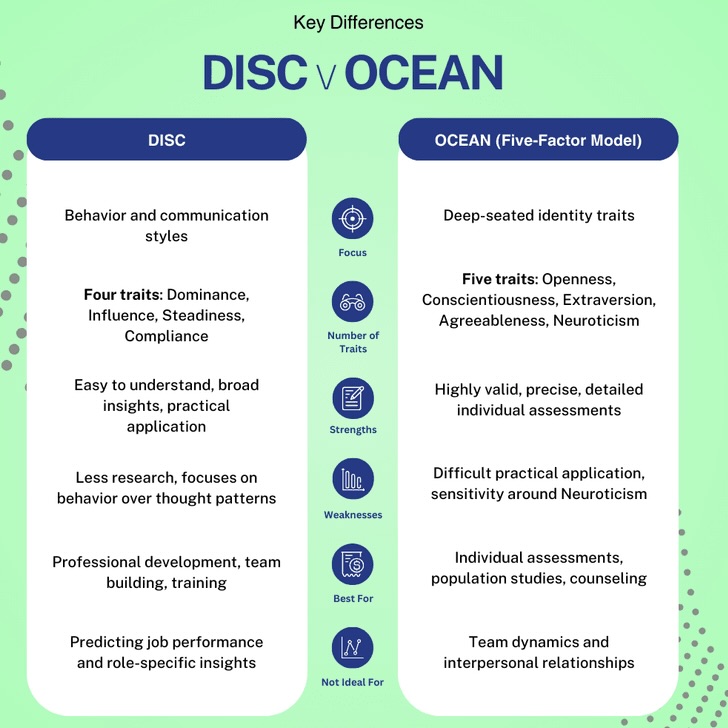
DISC and Big Five are both valuable tools for gaining insight into your personality and behaviour. However, they differ in their approach and scope. DISC is more focused on identifying specific behavioural tendencies and communication styles, while Big Five provides a broader picture of personality traits and tendencies. Additionally, DISC is often used in workplace settings to improve communication and teamwork, while Big Five is used in a variety of settings, including personal development and research. Ultimately, the choice between these assessments depends on your goals and the context in which you plan to use them.
Pros and Cons of DISC Assessments
One of the main advantages of DISC assessments is their simplicity and ease of use. They are easy to understand and can provide quick insights into a person’s personality. Additionally, DISC assessments are often used in team-building exercises and can help individuals learn to work more effectively with others. However, some critics argue that DISC assessments are too simplistic and do not provide a comprehensive understanding of a person’s personality. They may also be prone to biases and stereotypes.
Another advantage of DISC assessments is their versatility. They can be used in a variety of settings, from corporate environments to personal relationships. They can also be customised to fit specific needs, such as leadership development or conflict resolution. However, some people may feel uncomfortable with the idea of being labelled or categorised based on their personality traits. Additionally, DISC assessments may not be as practical in identifying more complex personality traits or disorders. It’s important to remember that while DISC assessments can provide valuable insights, they should not be the sole basis for making important decisions.
Pros and Cons of Big Five Assessments
The Big Five personality model is widely regarded as one of the most accurate and comprehensive personality assessments available. It measures five broad dimensions of personality: openness, conscientiousness, extraversion, agreeableness, and neuroticism. This model has been extensively researched and validated, and is used in a variety of settings, including clinical psychology and organisational psychology. However, the Big Five can be more complex and challenging to understand than DISC assessments, and may require more time and resources to administer and interpret.
One of the main advantages of the Big Five is its comprehensive nature. It provides a detailed, nuanced understanding of an individual’s personality, which can be helpful across a variety of contexts. Additionally, the Big Five has been extensively researched and validated, which lends it credibility and reliability. However, the Big Five can be more complex and challenging to understand than other personality assessments, such as DISC. It may also require more time and resources to administer and interpret, which can be a drawback in specific settings. Ultimately, the choice between the Big Five and other personality assessments will depend on the individual or organisation’s particular needs and goals.
Which assessment is more accurate?
Both DISC and Big Five personality assessments have their strengths and weaknesses, and it ultimately depends on what you are looking for in a personality assessment. The Big Five is widely regarded as one of the most accurate and comprehensive assessments available, but it can be more complex and time-consuming to administer and interpret. DISC assessments, on the other hand, are easier to understand but may not provide as much depth or accuracy in measuring personality traits. Ultimately, it’s essential to consider your specific needs and goals when choosing between these two assessments.
The Big Five personality assessment measures five broad dimensions of personality: openness, conscientiousness, extraversion, agreeableness, and neuroticism. It is often used in research and academic settings because it provides a detailed, nuanced understanding of an individual’s personality. However, it can be time-consuming and complex to administer and interpret, which may not be practical for some organisations or individuals.
Choosing the Right Assessment for your Needs
When it comes to choosing between DISC and Big Five personality assessments, it’s essential to consider what you are looking to gain from the evaluation. If you are looking for a quick and easy way to gain insight into your own personality or others’, DISC may be the way to go. However, if you are looking for a more comprehensive and accurate assessment that provides deeper insights into personality traits, the Big Five may be a better choice. Ultimately, it’s essential to do your research and choose the assessment that best fits your needs and goals.
DISC assessments are popular for their simplicity and ease of use. They focus on four main personality traits: dominance, influence, steadiness, and conscientiousness. These traits are measured on a scale of high to low, and the results can provide a basic understanding of how a person may behave in certain situations. DISC assessments are often used in team building and leadership development programs.
Internal Recruitment Articles

Benchmark Psychometric Assessment Providers
When was your last assessment "health check"?When Last did you Benchmark Psychometric Assessment ProvidersLet’s be honest: most of us have been using the same psychometric tests for years because “that’s just what we use.” But if your team is moving faster than your...

Crystallized and Fluid Intelligence
Cognitive Abilities Assessment TestUnderstanding Crystallized and Fluid Intelligence:Cognitive abilities are at the core of how we think, reason, solve problems, and learn new information. Two essential components that shape how we process the world around us are...