
Ravens Progressive Matrices
Ravens Progressive Matrices by Assess FirstImproved Talent Selection in Organisations
Ravens Progressive Matrices Online Candidate Test to Improve Talent Selection
Unlock potential with the Ravens Progressive Matrices Online Candidate Test, a powerful tool for enhancing talent selection and making informed hiring decisions. In today’s competitive business environment, the importance of talent selection cannot be overstated. Organisations continually strive to identify and recruit individuals who not only possess the necessary skills but also align with the company culture and values. The right talent can drive innovation, enhance productivity, and contribute significantly to achieving business goals. Conversely, poor hiring decisions can lead to increased turnover, decreased morale, and substantial financial losses. Effective talent selection processes are therefore crucial for organisational success.
Correlation to Predicting Future Performance
0.65
Ravens Progressive Matrices Online Candidate Test to Improve Talent Selection
Unlock potential with the Ravens Progressive Matrices Online Candidate Test, a powerful tool for enhancing talent selection and making informed hiring decisions. In today’s competitive business environment, the importance of talent selection cannot be overstated. Organisations continually strive to identify and recruit individuals who not only possess the necessary skills but also align with the company culture and values.
The right talent can drive innovation, enhance productivity, and contribute significantly to achieving business goals. Conversely, poor hiring decisions can lead to increased turnover, decreased morale, and substantial financial losses. Effective talent selection processes are therefore crucial for organisational success.

How Learning Agility is Measured
Non-verbal Cognitive Assessment
Abstract Reasoning
General Intellectual Ability
Fluid Intelligence
High Correlation to Predict Future Role Fit
0.65
Importance of Talent Selection in Organizations
Traditional methods of talent selection, such as interviews and resume reviews, often fall short in identifying the best candidates. These approaches can be subjective, and biases may inadvertently influence hiring decisions. As a result, organisations are increasingly turning to more objective and scientifically validated methods to improve the accuracy of their talent selection processes. One such method is the use of cognitive ability tests, which are strong predictors of job performance.
Among the various cognitive ability tests available, the Ravens Progressive Matrices (RPM) test stands out for its effectiveness in measuring cognitive capabilities. By incorporating this test into their recruitment process, organisations can make more informed hiring decisions and select candidates with the potential to excel in their roles. In the following sections, we will explore the Ravens Progressive Matrices test in detail, including its benefits, implementation, and comparison with other assessment tools.

What is Raven’s Progressive Matrices
Raven’s Progressive Matrices is a non-verbal cognitive assessment used to measure abstract reasoning and aspects of general intellectual ability, especially fluid intelligence.
It typically presents a series of visual patterns with one piece missing, and the person must choose the option that correctly completes the pattern. The tasks become progressively more difficult, which is where the name comes from.
In assessment contexts, it is often used to evaluate:
- Pattern recognition
- Logical reasoning
- Problem-solving ability
- Ability to identify relationships in visual information
It is popular because it:
- is less dependent on language
- can be used across different educational and cultural groups more easily than verbal tests
- focuses more on reasoning ability than learned knowledge
That said, it does not measure the full range of intelligence. It gives insight mainly into abstract and analytical reasoning, not personality, motivation, practical judgement, or all cognitive domains.

Examples in a Ravens Progressive Matrices Test
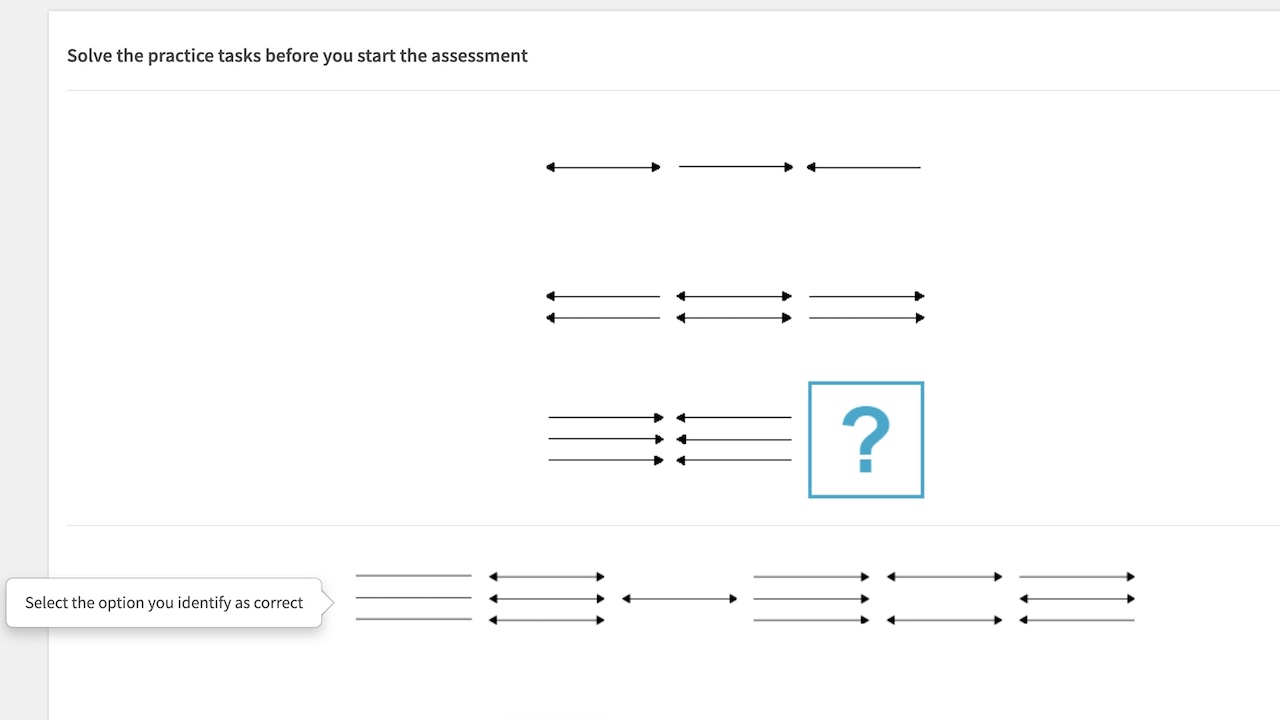
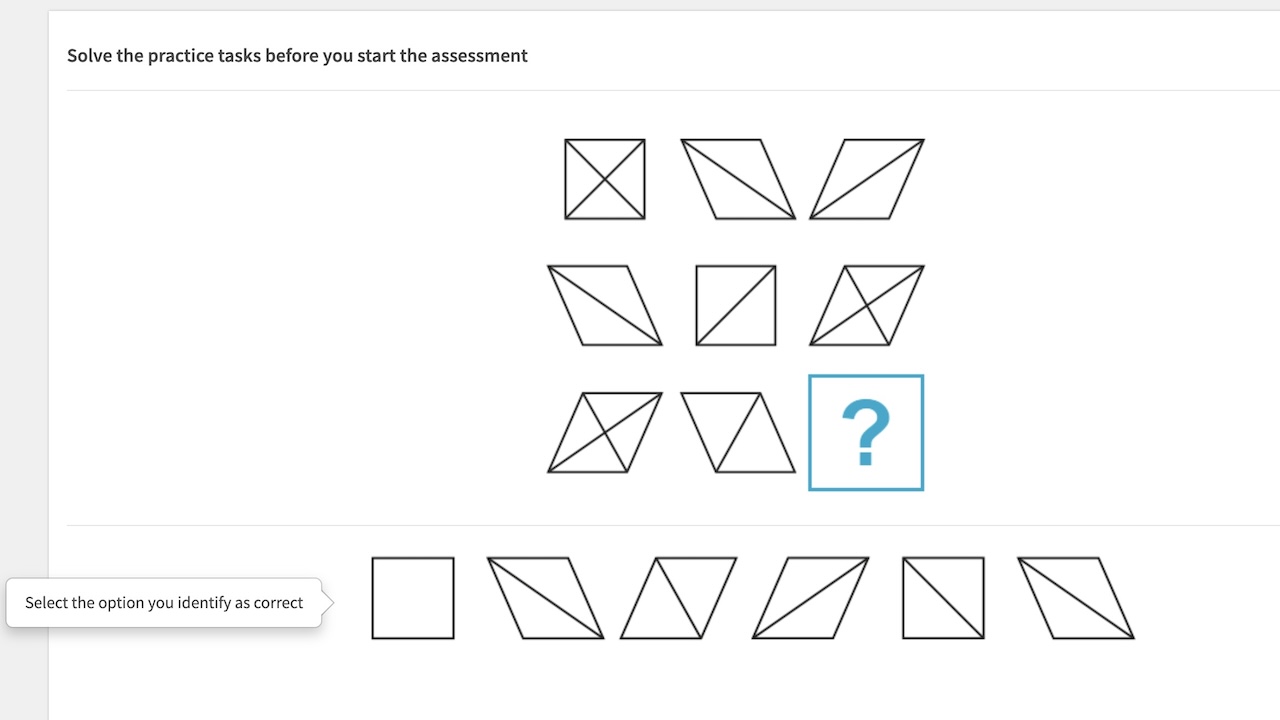
Matrigma is a non-verbal assessment that measures logical reasoning using geometric figures, called matrices. In each task, a set of matrices forms a pattern by following a logical principle.
For each set, one matrice is missing to complete the series. The missing matrice is always located in the lower right corner and is indicated by a question mark.
Your task is to work out the logic behind the series and select the matrice which completes it from among the six response options.
Overview of the Ravens Progressive Matrices Test
The Ravens Progressive Matrices (RPM) test is a non-verbal assessment tool designed to measure an individual’s abstract reasoning and problem-solving abilities. Developed by John C. Raven in 1936, the test consists of a series of visual puzzles that require candidates to identify patterns and complete sequences. The test is widely used in educational, clinical, and occupational settings due to its reliability and validity in assessing cognitive abilities.
The RPM test is typically divided into three versions: the Standard Progressive Matrices (SPM), the Colored Progressive Matrices (CPM), and the Advanced Progressive Matrices (APM). The SPM is designed for the general population, while the CPM is intended for younger children, older people, and individuals with cognitive impairments. The APM, on the other hand, is geared towards individuals with above-average intelligence and is often used in academic and professional contexts.
The test is administered online, making it accessible and convenient for both employers and candidates. Candidates are presented with a series of patterns, each containing a missing piece. Their task is to select the correct piece from a set of options to complete the pattern. The difficulty of the puzzles increases progressively, challenging candidates to employ higher-order thinking skills as they advance through the test. The RPM test’s non-verbal nature ensures that it is free from cultural and linguistic biases, making it an equitable assessment tool for diverse candidate pools.
How the Test Measures Cognitive Abilities
The Ravens Progressive Matrices test measures a range of cognitive abilities essential to effective job performance. One of the primary abilities assessed by the test is abstract reasoning, which involves the capacity to identify patterns, relationships, and logical sequences in visual information. Abstract reasoning is critical to problem-solving and decision-making, as it enables individuals to analyse complex information and generate innovative solutions.
Another key cognitive ability measured by the RPM test is fluid intelligence, the ability to think logically and solve novel problems independently of acquired knowledge. Fluid intelligence is particularly important in dynamic work environments where employees must adapt to new challenges and learn new skills quickly. By assessing fluid intelligence, the RPM test helps employers identify candidates who are likely to excel in roles that require adaptability and continuous learning.
The test also evaluates candidates’ attention to detail and concentration. Completing the RPM puzzles requires sustained focus and careful analysis of visual information. Candidates who perform well on the test are likely to demonstrate strong attention to detail in their work, reducing the likelihood of errors and enhancing overall productivity. Additionally, the test’s progressive difficulty levels provide insights into candidates’ perseverance and ability to handle increasingly complex tasks.
Benefits of Using Ravens Progressive Matrices in Recruitment
Incorporating the Ravens Progressive Matrices test into the recruitment process offers several significant benefits for organisations. One of the primary advantages is the test’s ability to provide an objective measure of candidates’ cognitive abilities. Traditional hiring methods, such as interviews and resume reviews, are often influenced by subjective judgments and biases. The RPM test, on the other hand, offers a standardised, scientifically validated assessment that can help reduce bias and ensure a fair evaluation of all candidates.
Another benefit of using the RPM test is its predictive validity. Research has shown that cognitive ability tests, including the RPM, are strong predictors of job performance. By assessing candidates’ abstract reasoning, fluid intelligence, and attention to detail, the test provides valuable insights into their potential to succeed in various roles. This can help organisations identify high-potential candidates who are likely to contribute to long-term success.
The RPM test is also highly versatile and can be used for a wide range of roles and industries. Whether an organisation is hiring for technical positions, managerial roles, or creative jobs, the test’s focus on cognitive abilities makes it relevant and applicable. Additionally, the test’s non-verbal nature ensures it is accessible to candidates from diverse cultural and linguistic backgrounds, promoting inclusivity in the hiring process.

Implementing the Test in Your Hiring Process
Implementing the Ravens Progressive Matrices test in your hiring process requires careful planning and integration to ensure its effectiveness. The first step is to identify the specific roles for which the test will be used. While the RPM test can be beneficial for a wide range of positions, it is particularly valuable for roles that require strong problem-solving skills, adaptability, and attention to detail. By targeting these roles, organisations can maximise the test’s impact on their talent selection process.
Once the roles have been identified, the next step is to integrate the RPM test into the overall recruitment workflow. This typically involves selecting an online testing platform that supports the administration of the RPM test. There are several platforms available that offer seamless integration with applicant tracking systems (ATS), allowing for efficient management of test administration and results. It is important to choose a platform that provides a user-friendly experience for both candidates and recruiters.
During the implementation phase, clear communication with candidates is essential. Providing candidates with information about the test, including its purpose and format, can help alleviate any anxiety and ensure that they are adequately prepared. It is also important to establish a standardised testing protocol that includes guidelines for test administration, time limits, and accommodations for candidates with disabilities. By maintaining consistency in the testing process, organisations can ensure the reliability and fairness of the assessment.
Interpreting Test Results: What Employers Need to Know
Interpreting the results of the Ravens Progressive Matrices test is a critical step in the talent selection process. The test generates a score that reflects the candidate’s performance on the visual puzzles, with higher scores indicating stronger cognitive abilities. However, employers need to consider test results alongside other assessment methods and candidate information to make well-rounded hiring decisions.
One key aspect of interpreting RPM test results is understanding the percentile ranks. Percentile ranks provide a comparison of the candidate’s performance relative to a normative sample. For example, a candidate who scores in the 75th percentile has performed better than 75% of individuals in the normative sample. These ranks can help employers gauge a candidate’s cognitive abilities relative to a broader population, providing valuable context for their performance.
Employers should also consider the specific cognitive abilities assessed by the test and how they align with the role’s requirements. For instance, a high score on the RPM test may indicate strong abstract reasoning and problem-solving skills, which are valuable for technical and analytical positions. However, it is important to balance these insights with other factors, such as relevant experience, cultural fit, and interpersonal skills, to ensure a comprehensive evaluation of the candidate’s suitability for the role.
Comparing Ravens Progressive Matrices with Other Assessment Tools
While the Ravens Progressive Matrices test is a highly effective tool for assessing cognitive abilities, it is important to consider how it compares to other assessment tools available in the market. One common alternative is the TalentIndex Cognitive Ability Test, which also measures general cognitive abilities. The TalentIndex test includes a mix of verbal, quantitative, and logical reasoning questions, making it a more comprehensive assessment of cognitive skills. However, the RPM test’s non-verbal nature makes it more accessible to candidates from diverse linguistic backgrounds.
Another popular assessment tool is the Myers-Briggs Type Indicator (MBTI), which evaluates personality traits rather than cognitive abilities. The MBTI categorises individuals into 16 personality types based on their preferences in four dimensions: extraversion/introversion, sensing/intuition, thinking/feeling, and judging/perceiving. While the MBTI can provide valuable insights into a candidate’s personality and potential fit with the team, it does not measure cognitive abilities, which are critical for many job roles.
The Situational Judgment Test (SJT) is another commonly used assessment tool that evaluates candidates’ judgment and decision-making skills in hypothetical work-related scenarios. While SJTs can provide valuable insights into candidates’ practical abilities and behavioural tendencies, they may not offer the same level of precision in measuring cognitive abilities as the RPM test. Ultimately, the choice of assessment tool should be based on the specific requirements of the role and the competencies most critical to success.

Case Studies: Successful Implementation in Various Industries
The Ravens Progressive Matrices test has been successfully implemented in various industries, demonstrating its versatility and effectiveness in enhancing talent selection processes. One notable example is in the Outsourcing sector, where companies such as OCFO have used the RPM test to identify candidates with strong problem-solving and analytical skills. These companies have reported significant improvements in their hiring outcomes, with the test helping to identify high-potential candidates who excel in technical roles.
In the healthcare industry, the RPM test has been used to assess cognitive abilities in medical professionals, including doctors, nurses, and allied health workers. Given the critical importance of attention to detail and problem-solving skills in healthcare, the test has proven to be a valuable tool for identifying candidates with the cognitive abilities to deliver high-quality patient care. Hospitals and healthcare organisations have reported improved job performance and reduced turnover rates after incorporating the RPM test into their recruitment processes.
The financial services industry has also benefited from the use of the RPM test in talent selection. Investment banks, insurance companies, and financial advisory firms have used the test to evaluate candidates for roles that require strong analytical and decision-making skills. By identifying candidates with high cognitive abilities, these organisations have built teams capable of navigating complex financial markets and making informed investment decisions. The test’s non-verbal nature has also ensured that candidates from diverse cultural backgrounds are fairly evaluated.
Conclusion: Enhancing Talent Selection with Effective Testing
In conclusion, the Ravens Progressive Matrices Online Candidate Test is a powerful tool for enhancing talent selection and making informed hiring decisions. By providing an objective, scientifically validated measure of cognitive abilities, the RPM test helps organisations identify candidates with the potential to excel in their roles. Its non-verbal nature ensures that it is accessible and fair for candidates from diverse backgrounds, promoting inclusivity in the recruitment process.
The benefits of using the RPM test in recruitment are numerous, including its predictive validity, versatility, and ability to reduce biases in the hiring process. By implementing the test in a structured, consistent manner, organisations can ensure they make data-driven decisions that contribute to long-term success. Additionally, interpreting test results alongside other assessment methods and candidate information enables a comprehensive evaluation of candidates’ suitability for the role.
As demonstrated by successful implementations across various industries, the RPM test can significantly enhance talent selection processes. Whether in technology, healthcare, or financial services, organisations that incorporate the RPM test into their recruitment strategies can build high-performing teams that drive innovation and achieve business goals. By embracing effective testing methods, organisations can unlock the full potential of their workforce and gain a competitive edge.

Self Awareness
Vital in Recruitment, Development, and Succession PlanningSelf Awareness: A Key Agility for Improving Recruitment, Development, and Succession PlanningIn the fast-paced world of talent management, organisations are continually looking for ways to improve their...

Results Agility
Results Agility and Business SuccessThe Link Between Results Agility and Business Success: What You Need to KnowIn today’s fast-paced business world, agility has become a crucial factor for success. That’s because companies that can quickly adapt to changing market...

People Agility
High People Agility = Improved Talent SelectionPeople Agility: A Crucial Element in Talent SelectionAs the business landscape continues to evolve, companies must adapt to new challenges and opportunities. One of the most critical factors in ensuring success is having...